Mu Cang Chai, the week the water comes
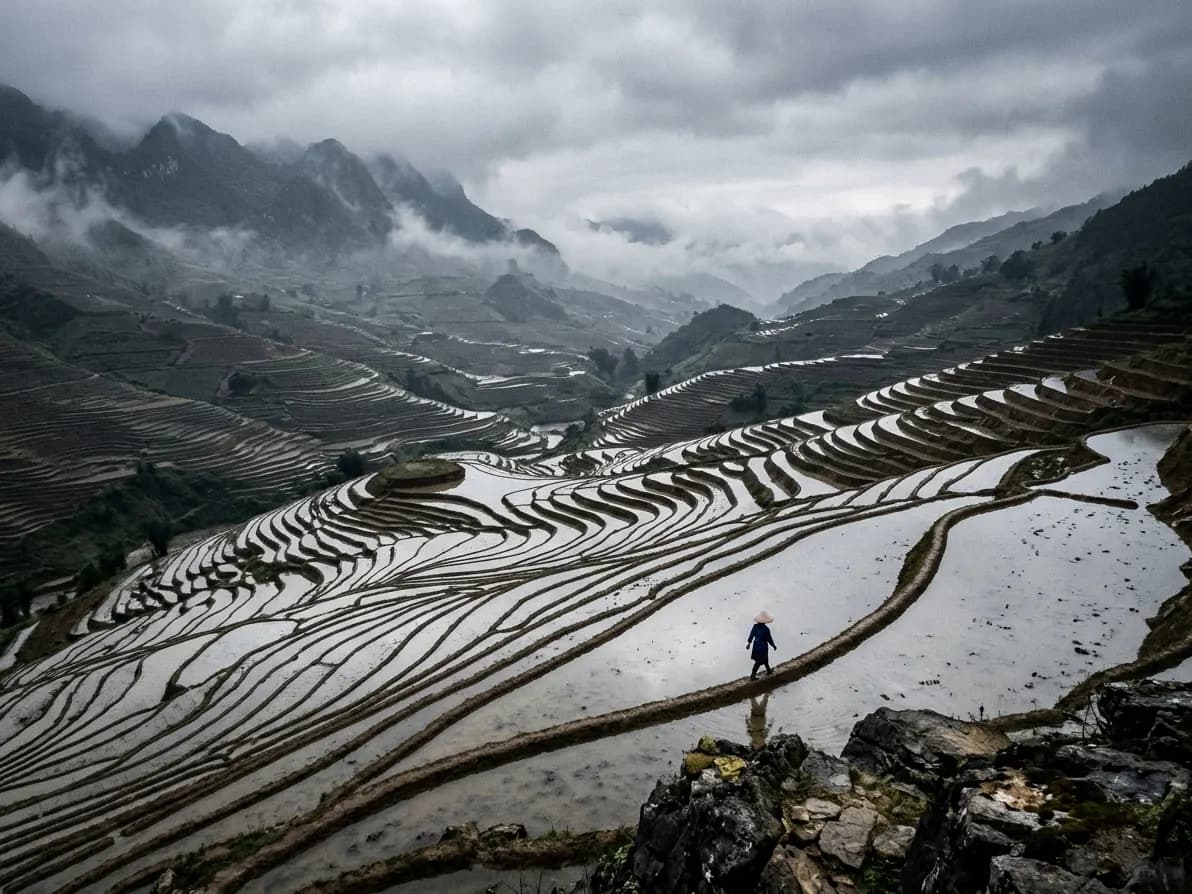
In late May, water is led down from the mountain streams into every terrace. For about ten days the whole valley becomes a staircase of mirrors.
By Lam Gia ThuyMu Cang Chai2 min read
In this story
Ten days of water
Most visitors come to Mu Cang Chai in September, when the rice turns gold. But many of the Hmong families who farm here say the flooding week is when the fields are at their best: ten days or so at the end of May and start of June, after ploughing, when the water has been let in and the seedlings haven’t gone down yet.
For those ten days each terrace is a mirror with its own shape, bent to the contour of the mountain. On a clear morning they hold the clouds. On an overcast one, like the morning I sat on a rock above La Pan Tan, they turn the colour of pewter. I counted more than sixty terraces on one slope before the mist took the rest.
Where the water goes
Giang A Pao, thirty-six, explained the route the water takes with bamboo sticks pushed into the bank. It comes off the stream into an earth channel almost two kilometres long, then spills from the higher terraces to the lower ones through small notches cut in the mud walls. When a terrace is full, someone closes the notch with a handful of earth. There are no valves and no plastic pipes.
Who gets water first is agreed in the village beforehand. Families whose fields are near the head of the channel take water first but have to repair the channel for everyone. In a dry year, Pao says, the meetings to share out the water can run into the night, and that is when people remember who helped whom the year before1.
The field is most beautiful when there’s nothing on it. Only water.
Lunch halfway up the mountain
Lunch for people working the fields at this time of year is usually sticky rice, smoked pork that has hung over the kitchen fire, and a bowl of plain mustard-green soup. Pao’s wife carried it up to their hut in a basket on her back, the rice wrapped in banana leaf. I was given a handful, still warm, so sticky it held to my fingers.
In town the guesthouses serve rice cooked in bamboo tubes, hill chicken and corn liquor. Dinner for two where we stayed was 380,000 dong. What I remember most, though, is the rice in the hut, eaten to the sound of water running between the terraces, with nobody saying anything.