Reading the Cai Rang floating market by its poles
Every boat hangs what it sells from the top of a bamboo pole. Ut Hanh has hung pumpkins from hers for twenty-two years.
By Ha Phuong NghiCan Tho2 min read
In this story
Five in the morning on the river
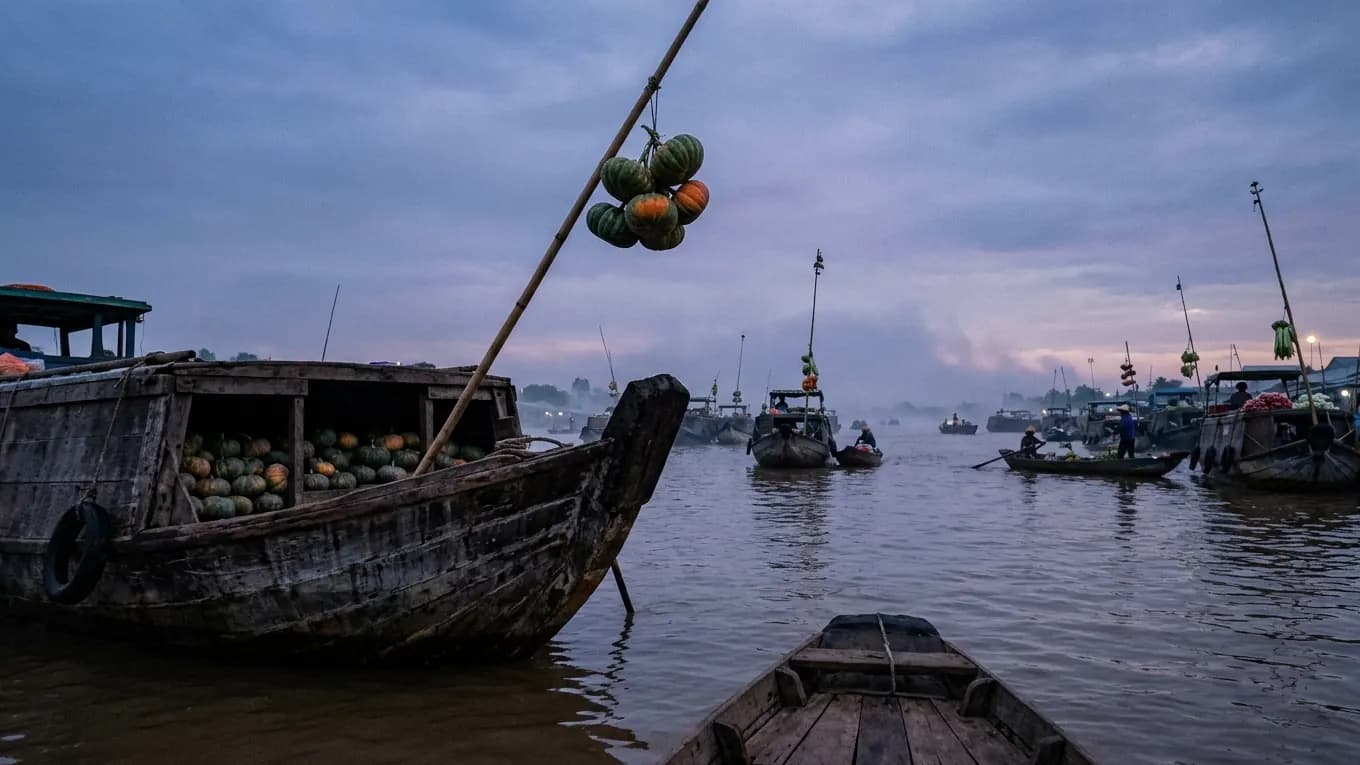
The Cai Rang floating market starts before it is light. By half past four the big boats from Phong Dien, Phung Hiep and Vinh Long are anchored in rows across the river, each carrying one main crop: pineapple, sweet potato, cabbage, watermelon. The buyers are wholesalers, stallholders from the markets on shore and restaurant owners. Tourists arrive later, after the big deals are done.
Nobody shouts. The job of a market cry is done by the cay beo: a bamboo pole planted at the bow, with the goods for sale hung from its tip. One pumpkin means pumpkins. Three sweet potatoes mean sweet potatoes. Some boats hang four or five things at once, a shop sign spelled out in produce1.
The pumpkin boat
Ut Hanh, forty-nine, has lived on a boat with her husband since 2004. It is fourteen metres long and carries about eight tonnes of pumpkins bought from fields in Long My. A load sits at the market for three to five days, depending on the price. On board there is a gas ring, a potted portulaca, a hammock, and a dog called Muc who has never been ashore.
“The pole is so people can see you from far off,” she told me, lobbing pumpkins one by one across to a buyer’s boat while both of them counted out loud. That morning pumpkins were 6,500 dong a kilo at the boat, sold in lots of two hundred kilos or more. The price, she pointed out, is the one thing you can’t hang from a pole.
The pole is so people see you from far off. The price, they have to come aboard for.
A market getting smaller
Traders who have worked here for decades say the market is shrinking. The roads are better, lorries run straight from the orchards to the wholesale markets, and fewer people need a boat. But every morning there are still a few dozen anchored mid-stream, and small sampans still weave between them selling noodle soup, iced coffee and baguettes to the people who live on board.
I bought a 15,000-dong iced coffee with milk from a sampan rowed one-handed by an old woman. The glass came on a loop of string, hooked over the side of our boat, so that handing it back took no reaching. It was the smallest detail I saw all morning, and probably the most carefully worked out.