Rice, ash water and forty years of kneading
In a small workshop behind Hoi An market, cao lau noodles are still kneaded by hand, steamed twice and delivered before the tourists wake up.
By Trinh Bao AnHoi An2 min read
In this story
Well water and wood ash
Truong Van Ky starts kneading at three in the morning, in a workshop of about twenty square metres behind a row of houses on Tran Phu street. The rice is soaked the afternoon before, wet-ground and pressed dry. Then he works it with ash water: water filtered through wood ash and left to settle for two days, slightly astringent, with a faint smell of smoke1.
The ash water is what makes cao lau chewy and gives it its ivory-yellow colour, nothing like pho noodles or rice vermicelli. He uses water from an old well in the neighbourhood, collected in two plastic jerrycans every Monday and Thursday. He isn’t sure the well water makes better noodles. He is only sure his father used it.
Steam, cut, steam again
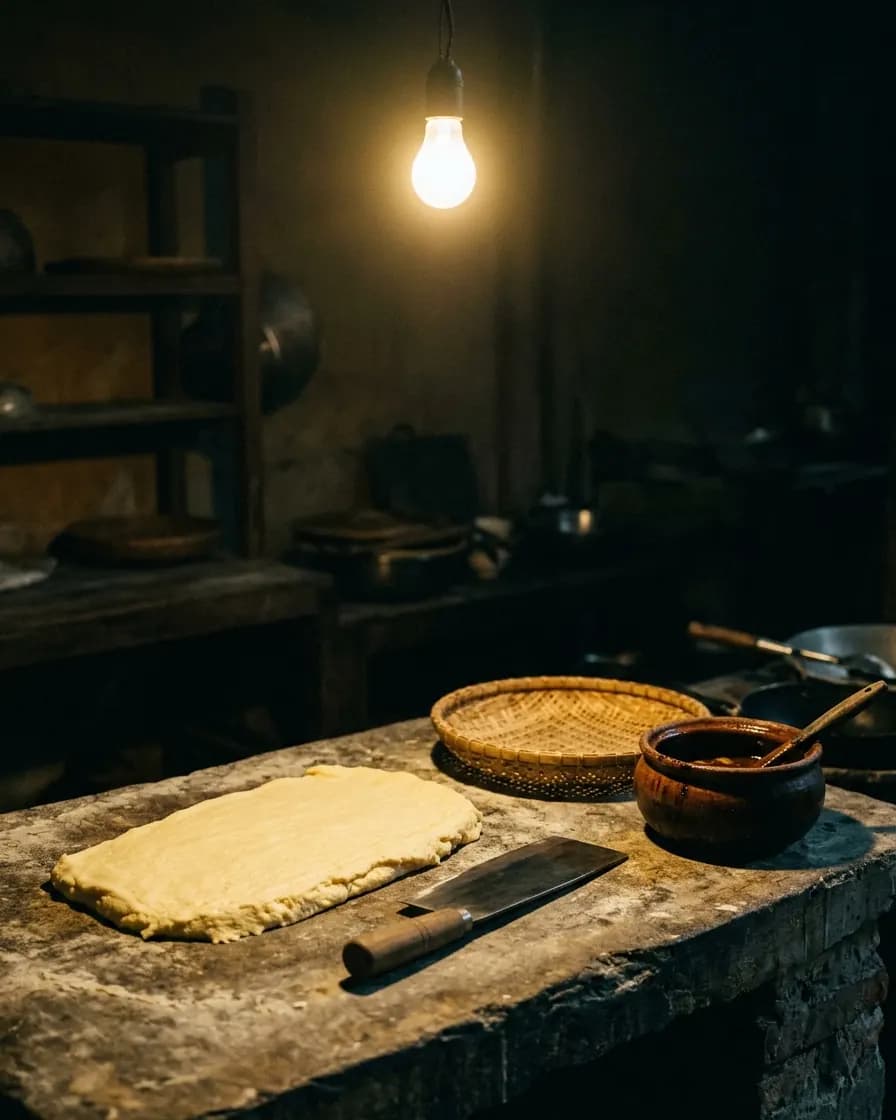
The kneaded dough is rolled into a sheet as thick as a finger and steamed once on bamboo trays until the surface sets. Then it is cut into square-edged strands with a wide-bladed knife he bought at a market in Da Nang in 1986, and steamed a second time. A small amount is fried into crisp squares to scatter on top of the bowl, the part customers tend to leave and Mr Ky considers the most important.
Each morning the workshop makes about ninety kilos of noodles and delivers them to fourteen restaurants in the old town before six. The wholesale price is 28,000 dong a kilo. In a restaurant, a bowl sells for 40,000 to 50,000 dong, with char siu pork, herbs from Tra Que village and half a ladle of thick sauce rather than broth.
Deliveries leave at half past five on a bicycle with a wooden crate strapped to the back, covered with a damp cloth. Quan rides; Mr Ky stays to clean. The route takes forty minutes and goes in the same order every day, so the first restaurant gets the warmest noodles and, according to the last one on the route, the restaurants at the end have been arguing about it since 1997.
You don’t pour broth on cao lau. Pour broth on it and it’s a different dish.
The last kneader
Mr Ky’s hands are calloused at the base of the thumb, where he presses the dough into the table about four hundred times a batch. He is sixty-eight. His son is an engineer in Da Nang; his daughter runs a tailor’s shop. The workshop has one apprentice, Quan, twenty-three, who has been with him for three years and now makes the third batch of the day on his own.
When I asked what was hardest to learn, he didn’t mention the ash water or the steaming. He talked about knowing whether the dough is ready from the sound it makes when you press it into the table. I couldn’t hear any difference. Quan nodded.