In Marzamemi, dinner ends when the sun finally gives in
Eight tables at the south-eastern tip of Sicily, where the owner doesn’t print a menu and nobody leaves until the fishing boats switch on their lamps.
By Lam Gia ThuyMarzamemi, Sicily6 min read
In this story
No menu
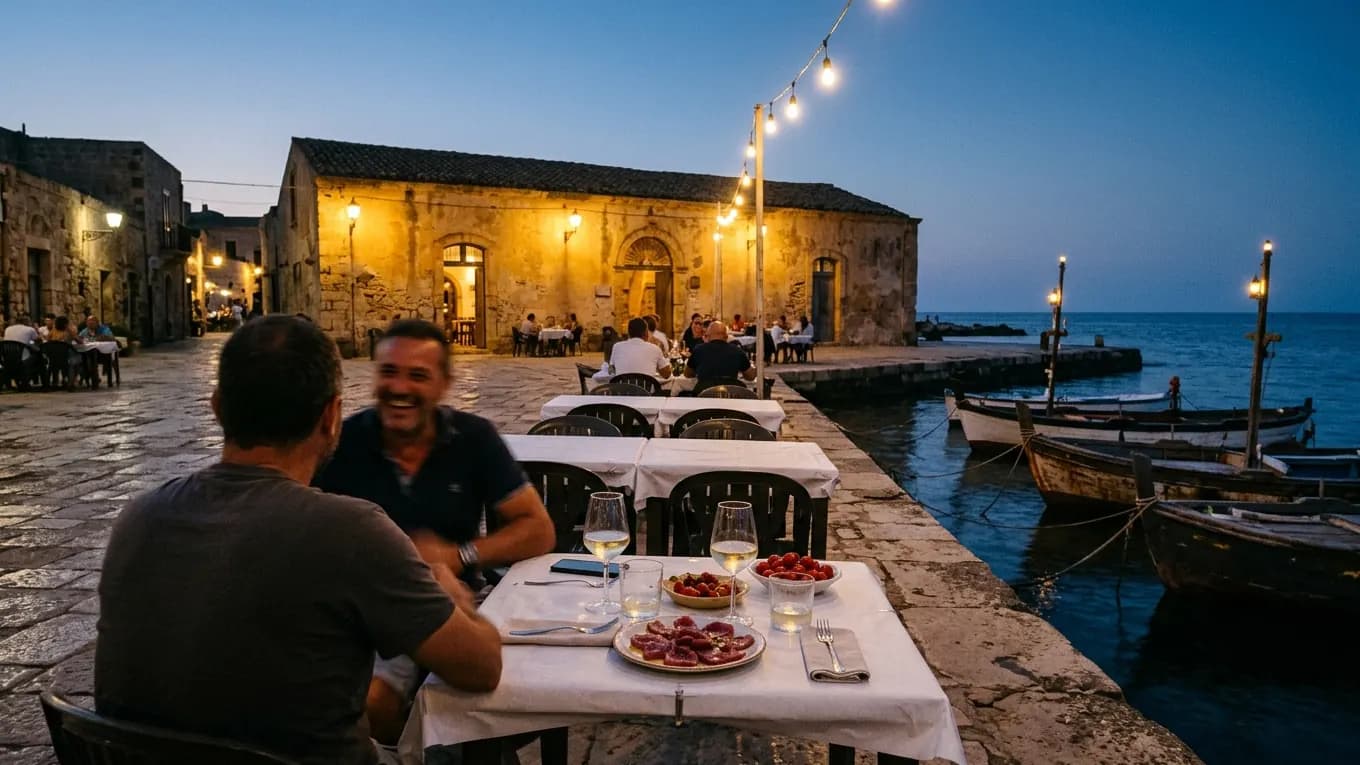
Da Rosalia has eight tables: four inside and four out on the quay, close enough to the water that salt dries on the rims of the glasses. There is no printed menu. At seven o’clock Rosalia Ferrante, sixty-one, walks the room once and reads out whatever the boats brought in that afternoon: bluefin tuna, cuttlefish, a few small groupers and, on a lucky day, red prawns with their antennae still on.
Ask the price and she gives you one number for the whole table. The night I sat there it was forty-two euros a head, which covered a jug of Grillo poured from a ceramic pitcher and a plate of Pachino tomatoes in olive oil that she calls the thing that opens your mouth.
The kitchen is a room four metres by three, with a two-ring burner, a charcoal grill made from half an oil drum and a fridge that hums loudly enough to hear from the quay. Her son Salvo cooks. Rosalia takes orders, pours, clears, and decides who gets the last red prawns. She has done this since 1989, when she took over from an aunt who ran the place as a bar for fishermen and served food only if you asked twice.
People find the quay by accident. Marzamemi has one square, a church, a handful of shops selling tins of tuna and jars of bottarga, and a harbour that empties at dawn and fills again in the afternoon. In August the village is packed with families down from Catania and Siracusa. In September, when I went, they have gone home and the sea is still warm enough to swim in before dinner.
Tuna, salt and season
Marzamemi grew up around a tonnara, a tuna trap and processing works that dates to the seventeenth century1. The long, low ochre building still stands at the back of the quay, its arches now holding shops and a few flats. The tuna don’t come past in the numbers they did in her grandfather’s day, but the habit of eating the fish part by part has stayed. The belly is grilled for barely a minute over orange-wood charcoal. The loin is sliced thin and dressed with blood-orange juice. The roe is salted, pressed and dried into bottarga, then grated over spaghetti the way other places grate cheese.
Salvo grills the belly in pieces the size of a playing card and turns them once, with his fingers. The fat catches and flares, and he pulls them off before the flame dies down. On the plate they are charred at the edges and pink inside, with nothing on them but salt and a few drops of oil.
“Nobody here eats tuna cooked through,” Rosalia said as she put down the third plate. I heard the next line again later from Salvo, then from a man at the next table, so I suspect it belongs to the whole village rather than to her.
Fish cooked through is fish that has died twice.
The cuttlefish come next, cut into ribbons and cooked in their own ink with a little tomato. Then a bowl of busiate, the corkscrew pasta of western Sicily, with pesto trapanese: almonds, basil, raw tomato, garlic and pecorino. Rosalia admits it is a Trapani dish, not a Marzamemi one. She serves it because her mother-in-law came from Trapani and because, she says, nobody has ever complained.
Six in the morning, the other end of the day
To understand the dinner you have to see the quay at the other end of the day. I went down at six on my second morning. The boats that had left the night before were coming back one by one, low in the water, gulls stitched to their wakes. There is no auction hall any more. The catch is sold off the side of the boats into blue plastic crates, by men who seem to agree a price without saying a number out loud.
Salvo was there in shorts and a fleece, a cigarette he never lit behind his ear. He bought two crates of cuttlefish, a single tuna loin wrapped in a wet sack, and a bag of red prawns that a fisherman handed over with the air of someone parting with a pet. He paid in cash from a roll held with a rubber band, and wrote the amounts in a school exercise book that also contained, on the back pages, his daughter’s maths homework.
Whatever he buys at six is what Rosalia reads out at seven that evening. If the boats come back with nothing, which happens when the wind is from the south-east and the sea stays up for days, the restaurant serves pasta, tomatoes and whatever is in the freezer, and charges less. Nobody I spoke to remembered it closing for lack of fish. Several people remembered it closing for a wedding.
By eight the boats are hosed down, the nets are piled on the quay to dry, and the men who caught the fish are asleep. The quay belongs to the cats and to a woman who sweeps it with a broom made of palm fronds. Twelve hours later the tables will be on the same stones, and the same men, washed and in clean shirts, will be eating at one of them.
The table nobody books
There are no reservations. You arrive, you stand near the door, and Rosalia either nods at a table or holds up a number of fingers that means minutes. The four tables on the quay go first. Regulars know to come at half past six, before the light changes, and to order a glass of wine standing up while they wait.
The table furthest from the door is never given to customers. It has a plastic chair with a cushion, a radio, an ashtray and a stack of receipts held down by a stone from the beach. That is where Rosalia sits between rounds, and where she eventually eats.
On my second night a German couple tried to sit there. Rosalia said nothing. She lifted the stone, put it back down on the receipts a little harder than necessary, and they moved.
When the boat lamps come on
The sun sets slowly in Marzamemi in September. At about ten to eight the light turns the colour of orange peel, and the four tables outside go quiet without anyone asking them to. Nobody takes out a phone, probably because everyone photographed this on an earlier night.
Then the colour drains out of the sky and leaves it a deep, even blue. The bulbs strung over the quay, which nobody noticed in daylight, become the only warm things in sight.
Dessert is not cake but a small bowl of almond granita, shaved so fine it melts on the tongue before you register that it is cold2. Salvo brings it out just as the lamps on the fishing boats come on, one at a time, like a clock striking.
The boats are going out for the night. Their engines start at around half past eight, a sound like someone clearing their throat in the next room, and they leave in a loose line past the end of the breakwater. By the time we paid, the harbour was empty and the water had gone black.
What it costs
Forty-two euros a head bought us tomatoes, two kinds of raw tuna, grilled belly, cuttlefish in ink, busiate, granita, a litre of Grillo between two and as much water as we wanted. There is no coffee; Rosalia sends you to the bar on the square, which closes at eleven. Cards are accepted, reluctantly, on a machine that lives in a drawer and has to be woken up.
Prices go up in August, when the village fills and the boats bring in less. They are not written anywhere, so the only way to know is to ask. Three dinners for two, with wine, came to €264.
We left just before ten on the last night. Rosalia had sat down at the back table with her own dinner: spaghetti with tomato and toasted breadcrumbs, pasta ca muddica, which she says customers never order because they don’t know it exists.
I asked if I could have it the next time. She looked at me for a moment, deciding whether I was serious, and said it wasn’t on the menu. I pointed out that there was no menu. She laughed for the first time all week, and wrote my name on the back of a receipt, under the stone.
Notes
- A tonnara is a system of fixed nets and a processing works for tuna, once common along the Sicilian coast. Most have closed; the old building in Marzamemi is now flats and shops.
- In Sicily granita is usually breakfast, eaten with a brioche. Serving it after dinner is this restaurant’s habit, not a regional rule.